The Guide to Attending the Martha Graham Winter Intensive in New York City
The Martha Graham Winter Intensive is an annual dance intensive every December/January for beginner to professional dancers. There is also a longer Summer Intensive every June/July, both taking place at the Martha Graham School. The Winter Intensive offers a recurring selection of Graham and technique classes over the course of three weeks.
I attended the Martha Graham Winter Intensive from December 30, 2024 - January 10, 2025.
This guide is based on my personal experiences and is in no way intended to discredit, defame, or maliciously criticize the event. Please refer to the organizer’s official website for the latest program updates and festival schedule.
Martha Graham is known as the "Mother of Modern Dance," reigning over the early 20th century. She's the creator of what's now recognized as Graham technique, a highly codified, physically demanding school of modern dance that requires years of progressive training.
The Martha Graham School in Manhattan's West Village houses the current Company's rehearsal studios, shared with students of the School and the summer and winter intensives. There are also extended options for Teacher Workshops and the popular Modern Classics Series.
I will be focusing solely on the Winter Intensive (WI).
With this guide, I hope to give you unfiltered, reflective insight into the particular quirks and workings of the Martha Graham WI, so you can be prepared when you go.
What is dance travel?
Your travel documents
The website
Choosing your workshops
A note about the schedule
How professional is "professional?"
Resources to practice with beforehand
The admission process
Performance and opportunities
Studio locations
The daily life
Scholarships
Managing your budget
Applying to grants
Accommodation
Food & groceries
Booking travel
Travel medical insurance
Pack like a dancer
Conclusion
What is dance travel?
Also known as “dance tourism,” dance travel is the dancer’s key to seeing the world while developing their craft.
dance travel — n. a means of travelling the world using dance as a catalyst and/or foremost purpose; activities can include taking workshops, attending festivals, teaching dance, and more.
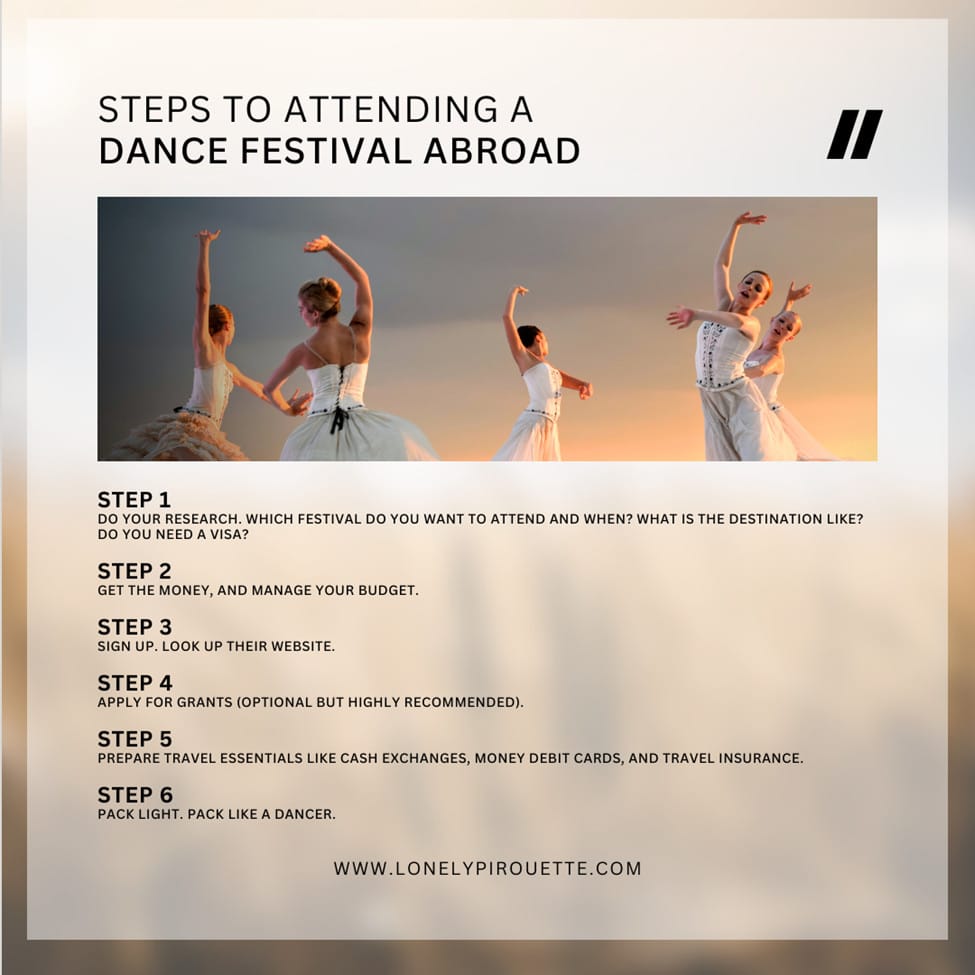
There are several steps to follow for attending any dance festival abroad or in-nation:
- Do your research. Which festival do you want to attend and when? What is the destination like? Do you need a Visa and/or ETA?
- Get the money, and manage your budget.
- Sign up. Look up their website.
- Apply for grants (optional but highly recommended!).
- Prepare travel essentials like cash exchanges, money debit cards, and travel insurance.
- Pack light. Pack like a dancer.
Your travel documents
If travelling from abroad, check that your passport is valid for at least 6 months beyond your trip. Check your government website for any visas or other documents needed for the destination, as well as risk advisories. Renewing your passport and/or applying for visas will all take some time, so factor this into your planning.
The website
The WI website is located at https://marthagraham.edu/winter-intensive/.
It's relatively easy to follow and straight to the point. Find the "Full Registration Instructions – Please Read" link underneath REGISTER NOW and click on it. You'll find a step-by-step document explaining everything you need to do to sign up and pay for the courses.
Back on the webpage, you'll find an overview of Graham technique, as well as core curriculum descriptions of each class offered, so you can decide which level is best for you.
I had a hard time choosing my level just from descriptions alone, so I contacted the school for an opinion. You can find their contact information at the very bottom of the page, under FOR MORE INFORMATION.
All the pricing is laid out clearly in a table both on the webpage and in the full instructions document.
Choosing your workshops
The WI offers three Graham levels: Graham I, II, and III/IV. Levels III and IV are in the same class.
You choose the courses you want to take, with the option of attending for one, two, or the full three weeks.
However, some courses like ChoreoLAB or Repertory require a minimum of three weeks of Graham. Others, like the Modern Classics Series, requires at least one week of Graham.
The following descriptions are sourced from their website and are to used as reference only:
GRAHAM I: Elementary
For students with little or no experience in the Martha Graham Technique, focusing on foundational principles and basic exercises. Goals include movement skills, concentration, and self-awareness.
GRAHAM II: Intermediate
For students with a solid understanding of elementary principles and a strong execution of all Level I material (e.g., seated contractions, deep stretches with spirals, turns around the back ending in pitch). Instruction builds strength, balance, stamina, focus, extended kinetic vocabulary, and an introduction to fundamental Graham phrases and repertory.
GRAHAM III: Advanced
For students with substantial experience in the Martha Graham Technique who demonstrate a strong command of all Level II material (including turns around the back to the strike, back leg extension with pleading to floor and recovery, sitting fall with spiral, and split fall). Instruction includes longer Graham phrases and repertory study.
GRAHAM IV: Advanced/Professional
Reserved for students with advanced and professional experience in the Martha Graham Technique, students learn extended Graham phrases and repertory, deepen physical and artistic mastery, and strive towards virtuosity as dance professionals.
Graham Teachers evaluate each dancer to ensure they are in the proper level. Students may not change level (higher or lower) during the Intensive without prior approval by their assigned Graham Instructor.
There are two ballet levels:
Advanced Beginner/Intermediate – Paired automatically with Graham I or Graham II due to scheduling conflicts.
Advanced – Paired automatically with Graham III/IV due to scheduling conflicts.
There are two contemporary levels:
Advanced Beginner/Intermediate – Paired automatically with Graham I or Graham II due to scheduling conflicts.
Advanced – Paired automatically with Graham III/IV due to scheduling conflicts.
There's a once-weekly Modern Classics Series masterclass:
Each week is different, focusing on one of Limón, Horton, or Dunham technique (Cunningham also used to be a possibility).
There are four courses with specific prerequisites. They require the full three weeks of the intensive, with at least one week of Graham technique.
ChoreoLAB – Previously known as Composition, this class is intended for you to experiment with different choreographic methods.
Improvisation – Exactly what it sounds like - exploring methods of improvisation.
Contemporary Partnering – Traditional and contemporary ways of partnering and sharing weight with another person.
Repertory – Learn Graham's classic choreography and rehearse in-studio. Goes at an Intermediate/Advanced pace.
Additional Courses:
There have been other courses within the WI that come and go based on demand. For example, Writing for Dance (or something along that name) was offered two years ago but removed due to low demand. (A travesty, since I would've loved to take that class, but that's just me.)
Check the website each year for the latest offerings.
A note about the schedule
I found it quite odd that the Graham levels and ballet/contemporary levels were tied together. Just as a professional dancer in general doesn't mean a professional Graham dancer, a Graham I dancer does not necessarily mean they are beginner or intermediate in ballet and/or contemporary.